

Lip Filler
Lip filler is not permanent; it is absorbed over time. The durability and side-effect figures on this page are not estimates but numbers drawn from our own patient series — written together with their limitations.
- Active substance
- Hyaluronic acid
- Procedure time
- Single session
- Longevity
- Not permanent. In our own series, most patients did not return for a repeat treatment within the first 12 months.
Frames filmed at the clinic
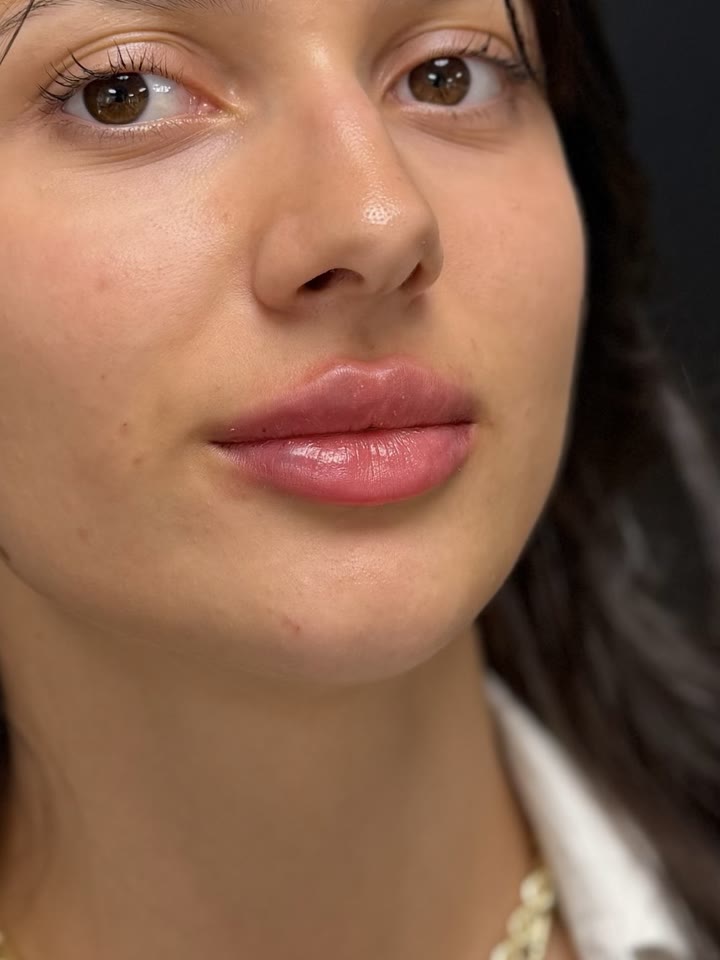
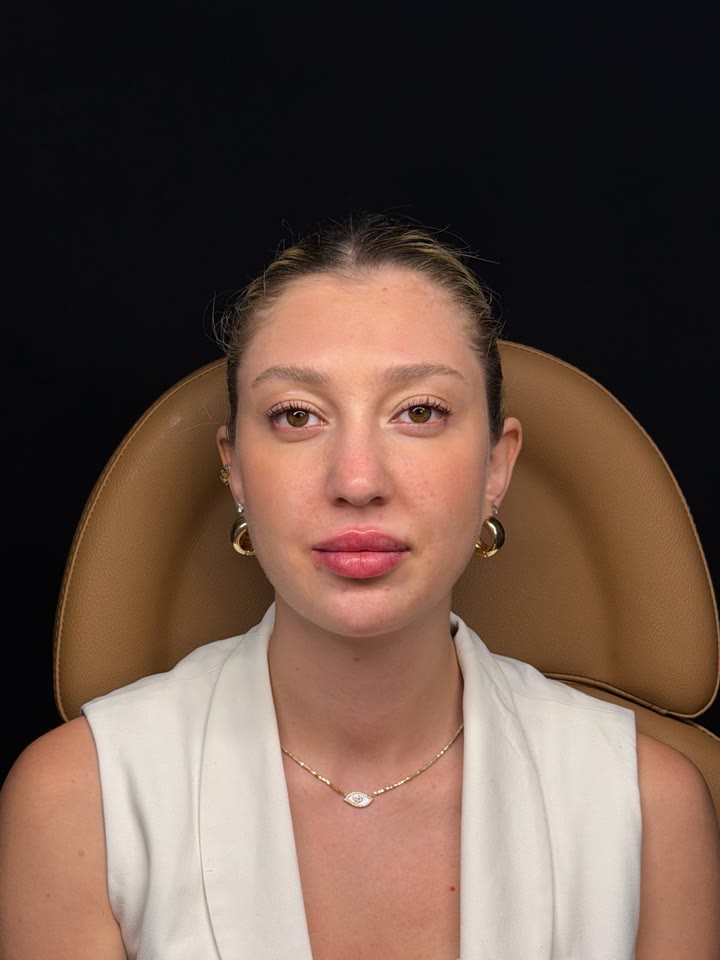
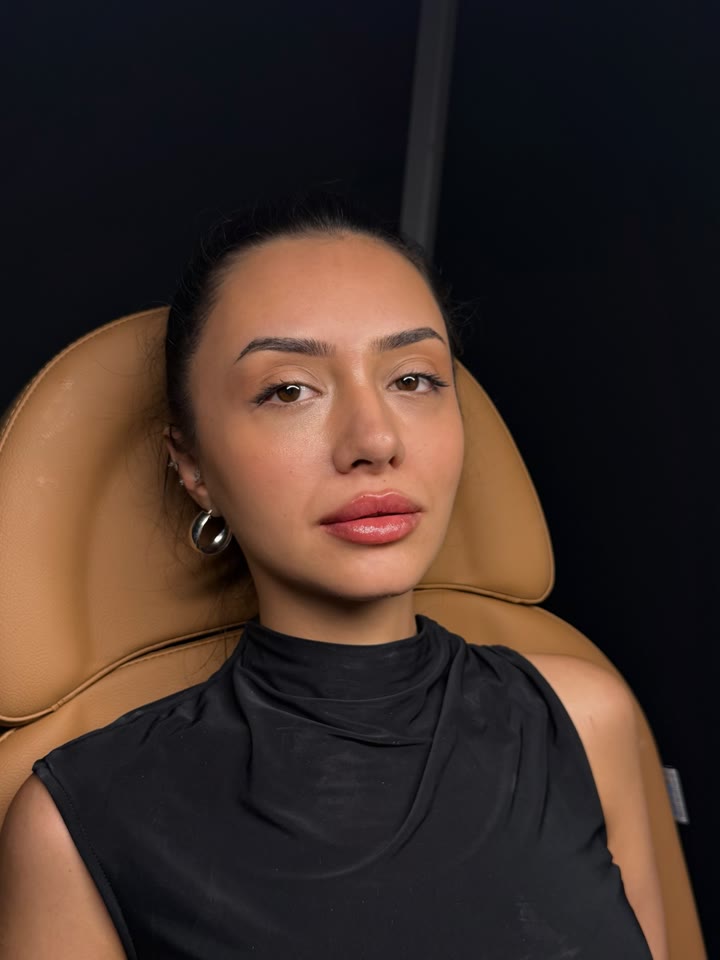
Results vary from person to person.
What is it?
Lip filler is a treatment that aims to change volume, border definition or symmetry by placing a gel containing hyaluronic acid into the lip tissue in a controlled way. Its effect is temporary; the gel is absorbed by the body over time.
What sets this page apart from the others is that its durability and side-effect sections are written not in general terms but with rates drawn from our clinic's own patient series. How the numbers were obtained, and where they fall short, is stated in the same place, because a number whose limits are not stated is not information but a claim.
Lip filler is performed by injecting a hyaluronic acid (HA) based gel into specific layers of the lip. HA is a polysaccharide that is also present in the body's own tissue; where it is placed it creates volume and binds the water around it. The lip is one of the most mobile and most looked-at areas of the face; together, these two features mean that a small disproportion here is perceived far more clearly than elsewhere. The aim is not always to add volume: in some people the real goal is to define the lip border, to balance the proportion between upper and lower lip, or to correct a one-sided asymmetry. These three goals require different amounts and techniques. The result is visible at the time of the procedure, but because of swelling in the first days the final appearance settles a few days later; so it is not advisable to judge by how it looks in the first 48 hours. The gels used differ in density and fluidity; in a mobile area such as the lip, more fluid forms are preferred, because a stiff gel does not look natural in movement and can leave a palpable firmness. The treatment is reversible: hyaluronic acid based fillers can be dissolved with the enzyme hyaluronidase. This is both a safety margin and a reassuring fact when deciding — a result you do not like does not stay with you permanently. The other side is that a result you like is not permanent either. Lip filler is not a procedure done once and finished but a treatment repeated if you want to maintain it; this needs to be taken into account from the start.
Dr. Burak Demirhan Explains
Why does 0.1 mm precision matter in lip asymmetry? (in Turkish)
English translation of the answer
Why does 0.1 mm precision matter so much in lip asymmetry? The lips are among the most mobile and most noticeable areas of the face, so even very small, millimetre-level differences can noticeably affect the result. With the measurements Aura provides at 0.1 mm precision, we can see the height, volume and proportion differences between the right and left sides of the lips very clearly. This data shows plainly where treatment is really needed and where we should stay conservative. That reduces the risk of adding more volume than necessary and lets us achieve more balanced, more natural results.
How can planning be made safer in lip, nose and chin filler? (in Turkish)
English translation of the answer
How does Aura make planning safer in lip, nose and chin fillers? Because these areas directly shape the expression of the face, the most important thing is getting proportion and balance right. Aura lets us assess these areas not one by one but in relation to the whole face. Facial proportion analysis lets us see in advance how a planned treatment will affect the overall balance of the face. The volume mapping feature shows clearly which areas of the face genuinely lack volume and which already have enough fullness. This prevents unnecessary or excessive treatment. As a result, we can plan in a more controlled, more natural way that respects the face's own proportions.
How much product is needed? What does our own data say?
One of the questions we hear most often is "half a millilitre or one millilitre?", and behind it there is usually an assumption: more product lasts longer. In our own patient series this assumption was not confirmed. Among patients who received 0.5 mL, 1.0 mL, and 1.5 mL or more at their first treatment, the rate of returning for a repeat treatment at 12 months was 26.3%, 28.0% and 28.1% respectively — that is, no significant difference could be shown between the three groups (p=0.27 for dose). In practice this means the amount should be decided not so that it "lasts longer" but on the basis of the volume your lip can carry and the look you are aiming for. More product does not give a longer-lasting result, only a fuller and often less natural one. This finding has one more consequence: increasing the amount is not a cost-saving strategy that reduces how often repeat treatments are needed. No such gain appears in our own data. This finding comes from a single practitioner's retrospective series and does not prove that there is no difference; it only says that such a difference was not shown in our data.
- Placement: the gel is placed into the target layer of the lip in small amounts.
- Goal: volume, border definition and symmetry require different amounts and techniques; the three are not the same thing.
- Swelling period: in the first days the lip looks more pronounced than it really is because of swelling.
- Absorption: tissue enzymes break the gel down over time; the effect diminishes gradually.
Treatment Areas
- Body of the lip — volume
- Vermilion border — defining the lip line
- Philtrum and corners of the mouth — support for proportion and direction
- Upper and lower lip balance — correcting proportion
- One-sided asymmetries
- What it cannot do: changing facial proportions outside the lip
Procedure Steps
Assessment
Lip structure, current proportions, skin quality and expectations are discussed. Whether the goal is volume, border or symmetry becomes clear at this stage; the three require different planning. If it is concluded at this stage that the procedure is not suitable for you, the treatment is not recommended; saying that an expectation cannot be met with filler is also part of the assessment.
Medical history
Medicines, bleeding tendency, allergy history, an active cold sore or skin infection, pregnancy or breastfeeding, and previous treatments in the area are asked about.
Preparation
The area is cleaned with antiseptic; a topical anaesthetic cream is applied and time is allowed for it to take effect.
Injection
The gel is placed gradually, in small amounts. The amount is decided not by expectations of duration but by the volume the lip can carry and the goal.
Assessment and review
The result is assessed once the swelling has resolved. A correction is planned if needed; which signs are normal and which are urgent is explained in writing.
Duration and Longevity
The honest answer to the durability question is not "it lasts this many months", because that varies from person to person. Instead we share something we can measure: when our patients came back for a repeat treatment. In our own series of 1,389 patients who had their first lip filler after 1 June 2023 (data frozen on 3 July 2026, median follow-up 328 days), the rate of returning for a repeat treatment was 18.9% at 6 months, 27.8% at 12 months, 33.3% at 18 months and 36.9% at 24 months. Read the other way round it is more meaningful: roughly three quarters of patients did not return within the first year. In the same series, the rate of filler being dissolved stayed at 1.6% at 24 months. These rates also reflect how the clinic works: returning depends not only on the lifespan of the product but also on the person's priorities at the time, their budget and how easily they can reach the clinic. So reading the number as a "duration" would be wrong. It is also necessary to say what these numbers are not. They measure not "how long the filler lasted" but "when the patient came back"; a person may not have returned for more than one reason, and this measure does not tell those reasons apart. The series is retrospective, belongs to a single practitioner, and is about 91% female with a median age of 29; this limits generalisability, especially for male patients. A single practitioner cuts both ways: it removes technical variability, so consistency within the series is high, but the results cannot be transferred directly to another physician's work. Because most patients had not yet returned by the freeze date, a median duration could not be calculated — which is why we give percentages at fixed months rather than a single "average duration".
Who is it suitable for?
- Adults aged 18 and over
- People who want to change the volume, border or symmetry of their lips
- People who come knowing and accepting that the result is temporary
- People who accept that the swelling period has to pass before the result is assessed
- People expecting a realistic and limited change
Who is it not suitable for?
- Pregnant and breastfeeding people
- People with a known allergy to hyaluronic acid
- People with an active cold sore (herpes) or skin infection — the treatment is postponed until it has healed
- People with a bleeding disorder or taking blood thinners (a physician's assessment is required)
- People who have previously had a filler that cannot be dissolved (permanent filler) in the area
- People who expect the rates on this page to apply to them exactly: the series belongs to a single practitioner, is retrospective, and is about 91% female with a median age of 29. Its generalisability to male patients and other age groups is limited; your decision is based on your own assessment at the examination.
Aftercare
- In the first 24 hours you can apply cold to the area at intervals.
- For the first 24–48 hours, avoid alcohol and any blood-thinning medicines your physician has not approved.
- In the first days, stay away from hot environments (sauna, steam rooms) and strenuous exercise.
- Do not massage, press or try to shape the lip yourself.
- If you have a history of cold sores, mention it beforehand; preventive treatment may be needed.
- In case of increasing pain, blanching or a bluish-purple colour of the skin, mottling or a spreading colour change, contact the clinic without waiting; these are not signs of normal healing.
Possible Side Effects
- Bruising — reported in 27.0% of 877 patients in our own patient series
- Swelling — 18.2%; expected in the first days
- Pain or tenderness — 9.8%
- Asymmetry — 6.0%; correction or dissolving may be considered after assessment
- Palpable firmness or nodule — 2.7%
- These rates were derived by keyword screening of patients' own messages; this is not a validated measurement tool, the period covered is August 2024 – July 2026, and the true frequency may be lower or higher. For infrequent headings such as infection, no rate is given because there are too few cases to interpret.
- Rare but serious vascular complications (tissue damage caused by the gel blocking a vessel) are outside the scope of this screening and are assessed separately. What should be kept in mind when reading this list is that most of the headings counted here are temporary and resolve on their own.
- What matters is knowing from the outset which signs are expected and which are urgent; this distinction is given to you in writing before the procedure.
Frequently Asked Questions
Who performs lip filler at this practice in Istanbul?
Lip filler described on this page is performed by Dr. Burak Demirhan himself at the practice in Küçükyalı, Istanbul. A consultation comes first; how much product goes where, or whether any treatment is done at all, is decided at that consultation. The durability and side-effect rates on this page come from the practice's own patient series.
Is lip filler permanent? How long does it last on average?
It is not permanent; the gel is absorbed over time. In our own series of 1,389 patients, the rate of returning for a repeat treatment was 18.9% at 6 months, 27.8% at 12 months and 36.9% at 24 months. So roughly three quarters of patients did not come back within the first year. This does not mean "filler lasts this long"; it measures when the patient came back.
Half a millilitre or one? Does more product last longer?
Not in our own series. In the 0.5 mL, 1.0 mL and 1.5 mL-or-more groups, the repeat rate at 12 months was 26.3%, 28.0% and 28.1%; no significant difference could be shown between the groups (p=0.27). The amount should be decided not by expectations of duration but by the volume your lip can carry and the goal.
Will my lip sag or lose its shape after the filler dissolves?
The tissue does not carry the injected volume permanently; as the gel is absorbed, the lip returns to its own state. The dissolving is gradual, not sudden. The long-term effect on the tissue of very large amounts applied again and again is a separate matter, and it is another reason for keeping the amount limited to the goal.
Does lip filler hurt? Is there pain during the procedure?
The lip is a sensitive area; a topical anaesthetic cream is used before the treatment. In our own series, pain or tenderness was reported by 9.8% of patients. Mild tenderness lasting a few days is usual; pain that increases and does not pass is not usual and should be reported.
When do swelling and bruising go down after lip filler?
In our own series, swelling was reported at 18.2% and bruising at 27.0%; both are expected and temporary findings. The appearance settles as the swelling resolves. It is not advisable to judge the result by how it looks in the first 48 hours.
Can lip filler be dissolved? In how many patients was it dissolved?
Hyaluronic acid based fillers can be dissolved with the enzyme hyaluronidase; this is a physician's procedure, and there is no method that can be used at home. In our own series the dissolving rate stayed at 1.6% at 24 months. Because the number of cases is low, the uncertainty around this rate is wide.
Is lip filler harmful? What are the risks and side effects?
The common side effects are temporary: bruising, swelling, tenderness, asymmetry, palpable firmness. The rare but serious risk is tissue damage caused by the gel blocking a vessel. For this reason the procedure should be performed by a physician, in appropriate conditions and prepared for an emergency. Blanching of the skin, a spreading colour change or severe pain after the procedure require urgent assessment.
Who is lip filler not suitable for?
It is not suitable for pregnant or breastfeeding people, people with a known allergy to hyaluronic acid, people with an active cold sore or skin infection, people with a bleeding disorder, or people who have previously had a filler that cannot be dissolved in the area. People with a history of cold sores may need preventive treatment before the procedure.
Is there an age limit for lip filler? At what age is it done?
The treatment is for adults. Age alone is not decisive; the physician decides by assessing expectations and anatomy together. The median age in our own series is 29.
Is lip filler done for men? Are the results different?
It can be. To be honest, though, our own patient series is about 91% female, so the generalisability of the rates on this page to male patients is limited. Male lip anatomy and the target proportions are also different, and the planning is done accordingly.
Does lip filler break a fast? Is there a religious objection?
Giving religious rulings is not the physician's role; the relevant authorities should be consulted on this. The medical side is this: the treatment is applied to the tissue and does not involve the digestive tract. If you tell us you are fasting, the appointment can be planned accordingly.
What determines the price of lip filler?
No price information is shared on this page. The factors that affect the assessment are whether the goal is volume, border or symmetry, the amount of product needed, the gel structure of the product, whether a review session is needed, and whether there has been a previous procedure in the area. Note: because our own data did not show that more product lasts longer, increasing the amount is not a way of saving either.
Where do the rates on this page come from? Are they reliable?
From two separate sources. The durability and dissolving rates come from a retrospective analysis of our own record series of 1,389 patients. The side-effect rates were derived from keyword screening of the messages that 877 patients wrote to the clinic themselves; this is not a validated measurement tool, and the true frequency may be lower or higher. Both sources belong to a single practitioner, are retrospective and consist mainly of female patients. The reason we share these numbers here is not a claim of precision; on the contrary, it is this: most of the durations circulating on this subject have no measurement behind them at all. A number with its limits stated is more useful than an "average" of unclear origin. Your own result will not necessarily match these averages; your situation is assessed separately at the examination.
Is there such a thing as needleless lip filler? Is it the same?
Promotional material about devices that deliver product by pressure is in circulation; these are not the same procedure as the injection treatment described on this page, and the data on this page does not cover them. It is advisable to ask at the examination which method will be used and which product.